


There is a pervasive narrative doing the rounds in the publishing industry, called ‘Google Zero’. This narrative, embraced by many industry leaders, poses that traffic from Google - search and Discover - will decline and eventually become negligible.
This Google Zero narrative is entirely false, and extremely dangerous. And I’m going to explain why.
If you’re expecting a newsletter about Google Discover, I’m sorry to disappoint. I know I’ve been promising a detailed article about optimising for Discover for a while, and I have a rough draft ready.
However, there has been so much written about Google Discover recently - especially in the wake of the Discover-specific algorithm update - that I’m not sure I can add anything meaningful. Instead, I’ll just point you to some great resources and insights:
How Google Discover REALLY Works - Leadership in SEO
How to Analyse Google Discover - Leadership in SEO
Google Discover’s 9-Step Content Pipeline - NewzDash
The Ultimate Google Discover Optimization Guide - Newsifier
Now, onwards to the real story.
The Road To Google Zero
When the concept of ‘Google Zero’ first began to emerge, I thought it could be a useful way to frame the strategic approaches publishers should consider when optimising for Google. But it’s taken on an entirely different meaning, one that is actively dangerous and downright false.
It’s true, gaining traffic from Google hasn’t gotten easier. Websites need to work harder to grow their share of Google visits, both in search and Discover. This is not a new development - the writing has been on the wall for nearly two decades.
Google started enriching its search results with all kinds of different elements in 2007, intended to provide exactly the kind of information Google’s users are looking for. The clean list of ten blue links has long been forgotten.
Since Google began introducing new elements into its search results, every new feature has diverted clicks away from websites. Often, these clicks were channelled towards Google’s own properties like YouTube, Google Maps, or the image search vertical. And increasingly, searches didn’t result in any click at all when the right information was shown to the user directly on the results page.
This trend continued with every new feature Google introduced into its results. Many websites were affected. Lawsuits were launched - some of which are still ongoing.
News publishers didn’t really feel the pain, however. On the contrary, the introduction of news carousels on Google’s results increased the traffic Google sent to publishers.
And then AI Overviews arrived, and everybody panicked.
Apparently The Verge’s Nilay Patel was the first to coin ‘Google Zero’ as a phrase, though I suspect he was more than a little inspired by Sparktoro’s Amanda Natividad and Rand Fishkin, who have been talking about ‘Zero Click Marketing’ for years.
I understand why Nilay is worried about Google. According to Similarweb, Google traffic to The Verge has been steadily declining since late 2023, predating the launch of AI Overviews.

Interestingly, this graph shows that Google is still the largest organic channel for The Verge, surpassed only by direct visits (which, by the way, are also declining). And you’ll also be interested to know that the periods of strongest Google traffic decreases on The Verge correlate with Google core algorithm updates and Site Reputation Abuse penalties.
I find it funny that The Verge seems to have an existential issue with the SEO industry as a whole. That too might contribute to their less than stellar performance in search. Not to mention the fact that every channel is sending less traffic to The Verge in recent years.
Perhaps it’s not entirely Google’s fault that The Verge is experiencing a decline.
Google Zero Isn’t Zero
One website’s editor complaining about Google traffic doesn’t make for a narrative. Yet somehow, the Google Zero story has become embedded in the publishing industry, with very little critical analysis.
A few weeks ago I was at a news-focused conference where one of the speakers presented a slide showing data from Chartbeat. This data indicated a huge decline in Google traffic to many of Chartbeat’s customers.
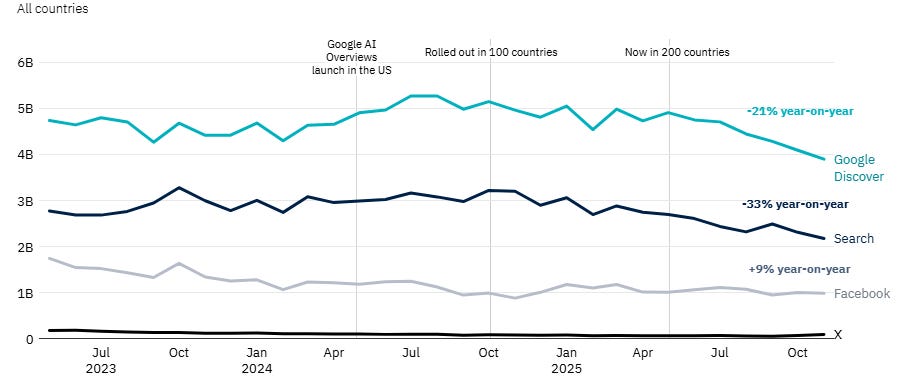
The data was published on the Reuters Institute’s website as part of their 2026 predictions, and seems to have been accepted as gospel by many in the industry.
The speaker who presented this slide works for one of my clients. I have access to this client’s Google Search Console data for dozens of their websites across Europe. I know exactly how much Google traffic they’ve lost in the last few years.
They haven’t lost any.
In fact, the speaker’s employer is showing growth in Google traffic across many of their websites. Yet the speaker presented the Chartbeat graph as fact, without any caveat, despite having access to a wealth of data that contradicts it.
It’s not just my clients - Press Gazette recently did a deeper dive into the Google Zero panic, speaking with many UK publishers. A clear consensus emerged: Google traffic isn’t actually declining all that much.
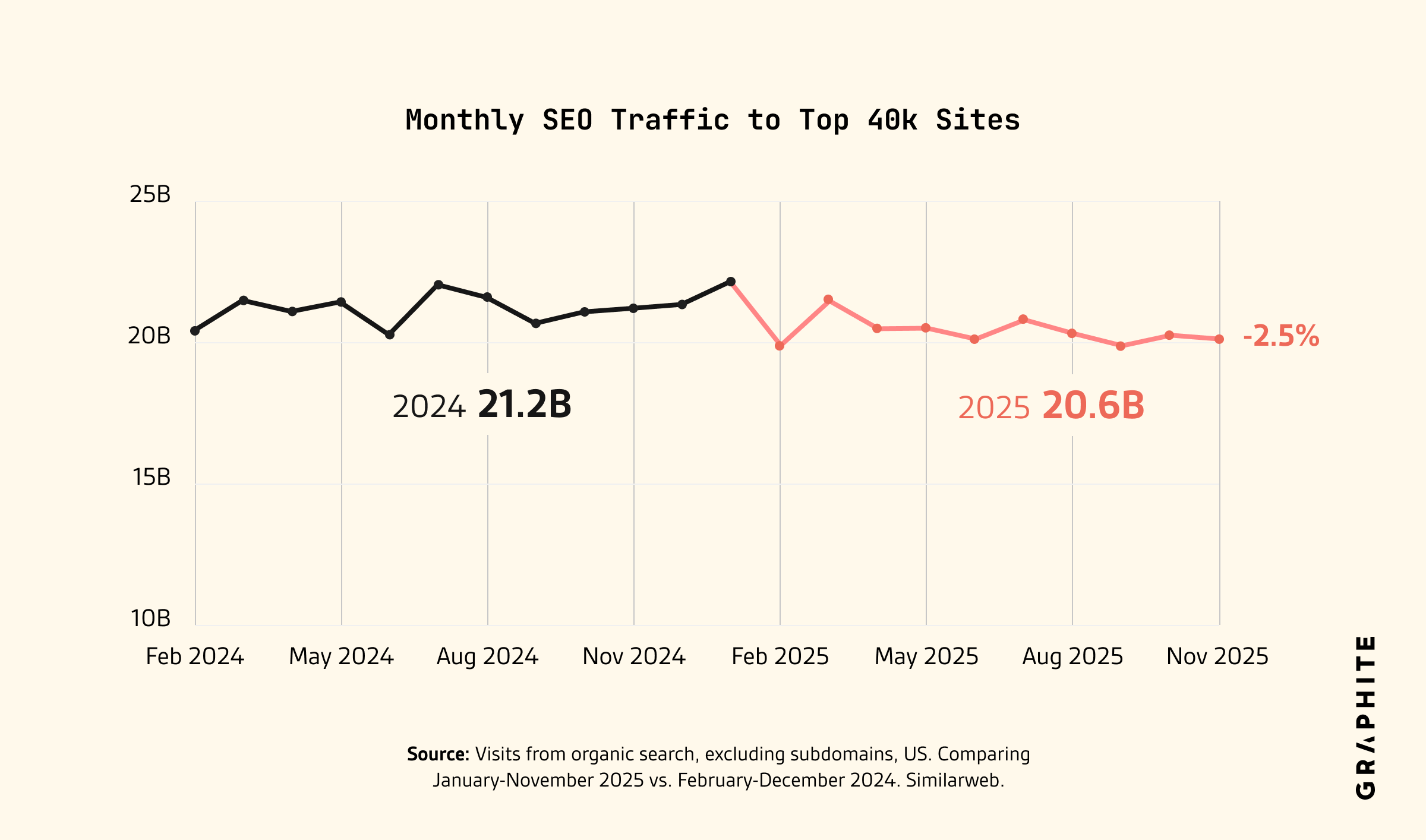
This is supported by data from Similarweb, published by Graphite, showing the actual decline of Google traffic to the top websites on the global web is… drumroll… two and a half percent.
So, why does the Chartbeat data show such a strong decline, and other sources do not? I have theories. One is that Chartbeat’s data is skewed by several of their largest clients, who may have suffered from Google’s core algorithm updates and Site Reputation Abuse penalties.
The Chartbeat data appears to be a simple aggregate, not taking individual sites’ comparative sizes into account. So when a few big sites experienced strong losses, it would skew the data heavily towards a decline, even when dozens of smaller sites don’t see any meaningful decreases.
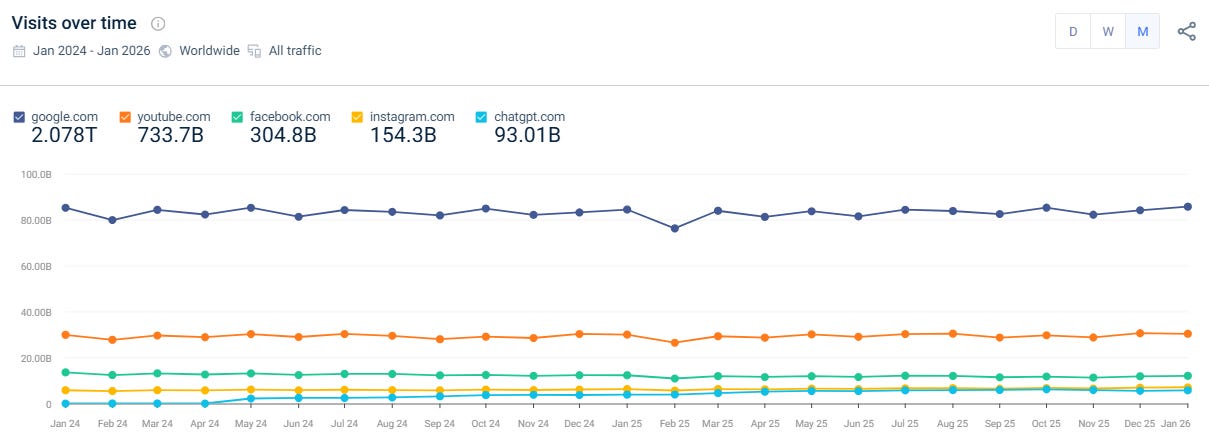
When we look at Similarweb’s data on global web traffic, Google is still by far the most-visited website in the world, accounting for nearly 20% of all web visits. This hasn’t changed in any meaningful way in the last few years.
A Self-Fulfilling Prophecy
Despite an abundance of contradicting data, the Google Zero panic has permeated the publishing industry. Not a week goes by without some C-level leader at a publisher declaring a shift away from Google towards other channels for audience growth.
I’m all for diversifying traffic sources. Publishers need to be less reliant on Google for their traffic, and have alternative sources of visitors that can sustain their business model. I’ve been on record saying exactly that for years.
But traffic diversification should not come at the expense of SEO. When you take your eye off the Google ball, you’re making a colossal mistake.
No matter how you interpret the data, Google is still by far the single largest source of visitors for websites. There is literally no other channel that comes close (keeping in mind that direct traffic isn’t a channel - it’s all traffic where there is no referral string associated with the visit).
Yes, it’s gotten harder to win in Google. I’ve outlined some of the underlying reasons in my AI Survival Strategies newsletter.
But when things get harder, the dumbest course of action is to give up.
If you lower your investment in SEO, guess what happens? You lose more Google traffic. This will then reinforce your preconceived notion of Google Zero, so you invest even less in SEO, and down the spiral goes until you’re dead in the water.
Your Google Zero prophecy has come true, because you’ve made it come true.
In the meantime, competing websites that continued to invest in SEO will happily scoop up the clicks you’ve abandoned.
There is literally no sign that Google is in danger of losing its position as the largest source of traffic to the web. There is no other channel rising to take Google’s place. Choosing to abandon Google is a potentially catastrophic strategic error.
Consider yourselves warned.
SPUR Coalition
Last week the SPUR (Standards for Publisher Usage Rights) Coalition was officially launched. Masterminded by David Buttle, this ‘NATO for News’ group aims to establish shared AI licencing standards and protect the interests of journalism businesses.

The founding members are the BBC, FT, The Guardian, The Telegraph, and Sky News - huge media brands with strong bargaining positions. Combined, the SPUR Coalition looks to form a powerful block that AI companies would do well to engage with.
More details on the SPUR Coalition website.
New Podcast Episode
Steve and I recorded another episode of our Beers & SEO with Barry & Steve podcast, this time featuring our very first guest - none other than Reach’s Nicola Agius!

The main topic of discussion was Google Discover, and we also cover the latest news and developments in the broader world of SEO.
Check out the podcast on your favourite platform via this link.
Miscellanea
Official Google Docs:
Help your readers find your site through preferred sources in Google Search
Added information to the Get on Discover page for site owners
Clarified information about the default file size limits for Googlebot
Interesting Articles:
Ad lobby seeks law to protect publishers from AI scraping - Axios
Google AI Overviews cite YouTube more than any medical site for health queries, study suggests - The Guardian
Majority of CEOs report zero payoff from AI splurge - The Register
The Great Masquerade: How AI Agents Are Spoofing Their Way In - DataDome
Never Ask an AI Tool How It Came Up with That Answer - Sparktoro
Why publishers are building their own creator networks - Digiday
ChatGPT, LLM referrals convert worse than Google Search - SEL
Latest in SEO:
AI Search has a Spam Problem - DEJAN
Are Citations in AI Search Affected by Google Organic Visibility Changes? - Lily Ray
Will Google Allow Publishers To Claim Google Discover Profiles - SER
Google Exploring Ways To Allow Sites To Opt Out Of AI Overviews & AI Mode - SER
Best TikTok Publishing times, Al Jazeera, Google Discover, Sun Video & William Gibson - Publishing Strategies
Interviews with me:
Are we freaking out about AI too much? - WTF is SEO
The Biggest Mistakes News Publishers Make in SEO - SEO by Marta
Barry Adams on SEO, AI and the future of news publishing - Storycue
That’s it for this one. As always, thanks for reading and subscribing, and I’ll see you at the next one.
Great stuff as always, Barry.
A note on the Chartbeat data as I also messaged that here @ WaPo: the November YoY comparison is a really poor one, given 2024 was a U.S. presidential election. All publishers are going to see relative decline from that huge news moment. If you do a more apropos YTD comparison (Jan-Nov), the delta's more like -15%; not -33%. Context is so important.
I have been waiting for someone to shoot holes in the Google Zero narrative, especially around Chartbeat data, which has been the source for more false publisher theories in the past 10 years than I can count.
Publishers have a habit of looking at the easily packaged narrative instead of thinking critically about their own brand performance, and then only talking with other publishers... instead of the many other business verticals that primarily exist online. It's an extrapolation of journalists whose only friends are other journalists... at some point in your adult life, you have to expand your worldview by talking to people from different fields in a non-transactional capacity (i.e., outside of building a story).
If there are 30 prominent organic digital strategies across all the industries who are invested in building business online, publishers typically use about 5 of them and ignore the rest. In my view, it's ego more than anything... publishers feel entitled to user attention that they haven't bothered to earn.
I like The Verge, but agree that they're weirdly reticent to acknowledge that organizing and optimizing their content for different kinds of audiences could help their business.